





I wanted to build my first Android app, but I already had too many ideas in my head. So I asked AI to help me find the best approach and the best product to start with.
It came back with plans, features, and more ideas than I expected. As I read through them, each option sounded possible and seemed as if it could work.
That should have made the decision easier. Instead, it made it harder.
AI had not given me bad ideas. It had given me too many good-sounding ones.
I did not need another product idea. I needed a way to decide.
The loop I got stuck in
This was the loop:
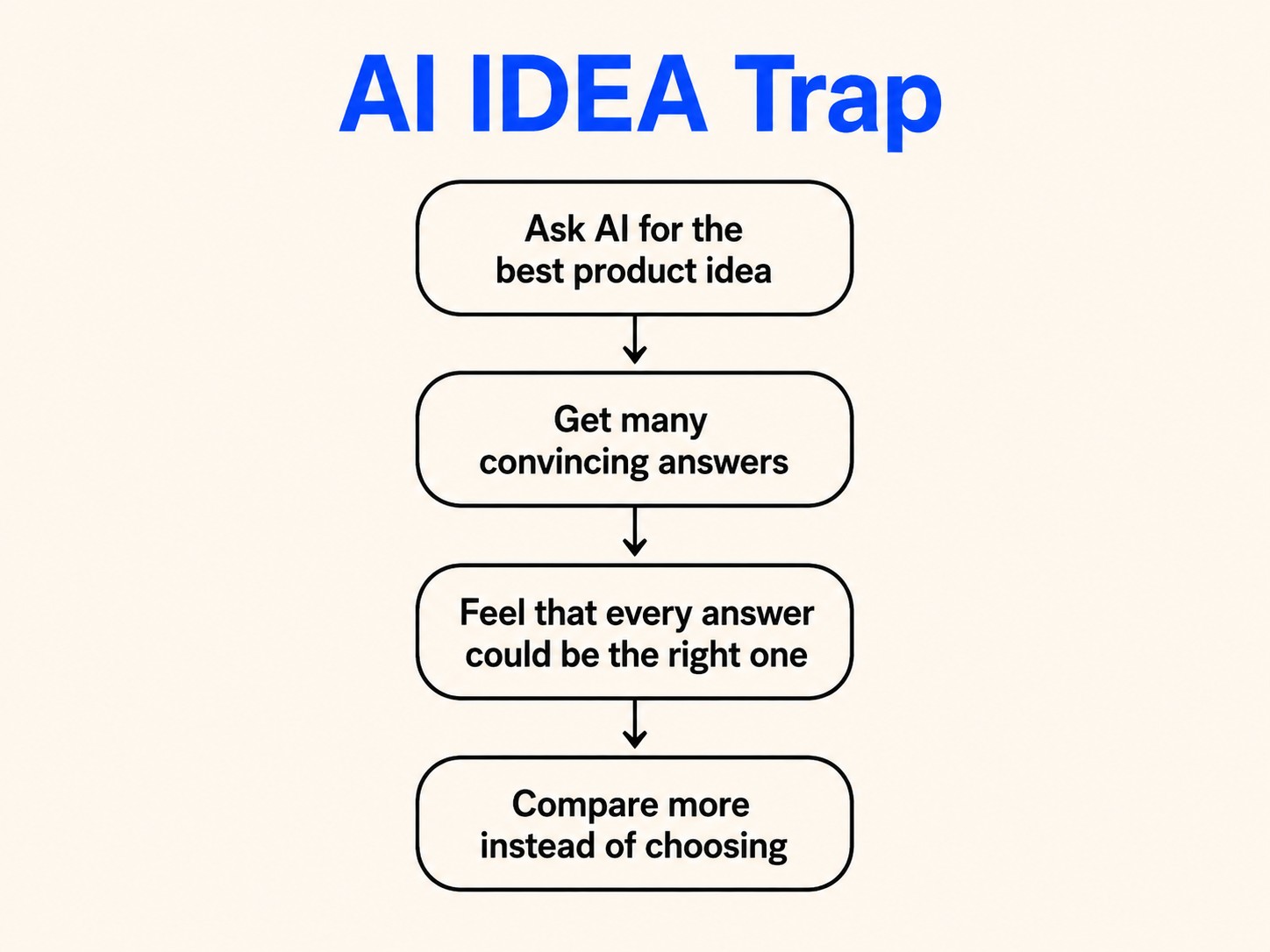
I was busy. I had material. I had plans.
But I was not closer to my goal.
Research on choice overload says that too many options can make a decision harder when the choices are complex and you are not sure what you want yet.
That was me. I had options, but no clear way to judge them.
The real issue was the question I was giving AI.
Before asking AI for another answer, it also helped me pause and ask whether I was using the tool for the right job. I use a simple three-question rule before opening any AI tool when I need that pause.
The question I changed
I stopped asking:
“Which product should I build?”
I started asking:
“What problems are people actually facing?”
That one change took me out of the product list and into a different type of work.
I started looking at problems from two sides: what I noticed in people around me, and what I experienced as a user myself. Instead of treating every issue as something negative, I started seeing some of them as opportunities to understand.
Not every problem needs a product. Not every problem is worth solving. But a problem gives you something real to investigate. It gives you a reason to ask better questions.
The method that helped me move
This is the small method I found for myself:
| Before | After |
|---|---|
| Ask AI for product ideas | Ask AI to help identify a real problem |
| Compare features | Understand who is struggling and why |
| Look for the “best” answer | Look for a starting point worth testing |
| Let AI list options | Ask AI to research, question, argue, and debate |
The last part mattered most.
I did not want AI to simply agree with my first thought. I asked it to question me, show another perspective, and point out what I might be missing. It asked things that I would not have asked on my own.
That did not replace customer research, a business analyst, or my own judgement. It gave me a better conversation with myself.
There is limited research that points in the same direction. In an experiment on evaluating summaries, AI-written critiques helped people find more flaws. My situation was different, but the useful idea was similar: AI can help you see a question you were not asking yet.
If you are in the same loop
When AI gives you many good options, do not force yourself to choose one immediately.
Pause and write down the goal you are actually trying to reach. Then ask AI to help you understand the problem behind that goal.
You can start with:
Help me understand the problems people face with [area]. What are they doing today? What is frustrating about it? Which questions would I need to answer before trying to build a solution?
That process did not tell me that I had found a guaranteed successful app. I do not know that yet.
But it helped me find my own way to start. I found a problem I was facing, a problem that might help other people too, and a place where I could begin building.
For me, that was better than another list of exciting ideas.
