





When I started using AI tools for my work, I used them for basic tasks, like drafting emails, summarizing long content, and other regular stuff.
However, I started noticing that I was not happy with the first version of the response. So I asked AI to give me a better version, then a shorter version, then a version with bullet points, and then a more professional version.
I was giving too many prompts to get something simple and easy.
I was literally exhausting AI in the idea of creating a perfect response.
AI felt too easy to use. I had the flexibility to open ChatGPT, Claude, Gemini, or any other AI tool, type a question, and get an answer in seconds.
But I started to wonder. I am asking so many questions recklessly. What if AI started charging me for every prompt? Would I still ask the same questions?
Would I still use it so easily, where I just keep pushing prompts without a clear end in mind?
When I started putting a visible cost upfront, it changed my behavior towards the way I use AI.
The problem is that AI feels free, so we sometimes use it without discipline. Without knowing it, we are spending something more than money here.
The hidden cost is not only money
Even though AI is not financially heavy for a normal user right now, it can still be mentally expensive.
The whole point of AI is to make our work easier. But if, instead of making things easier, it starts giving us decision fatigue, then we have to rethink the way we use it.
AI personally cost me a few things in the beginning, such as:
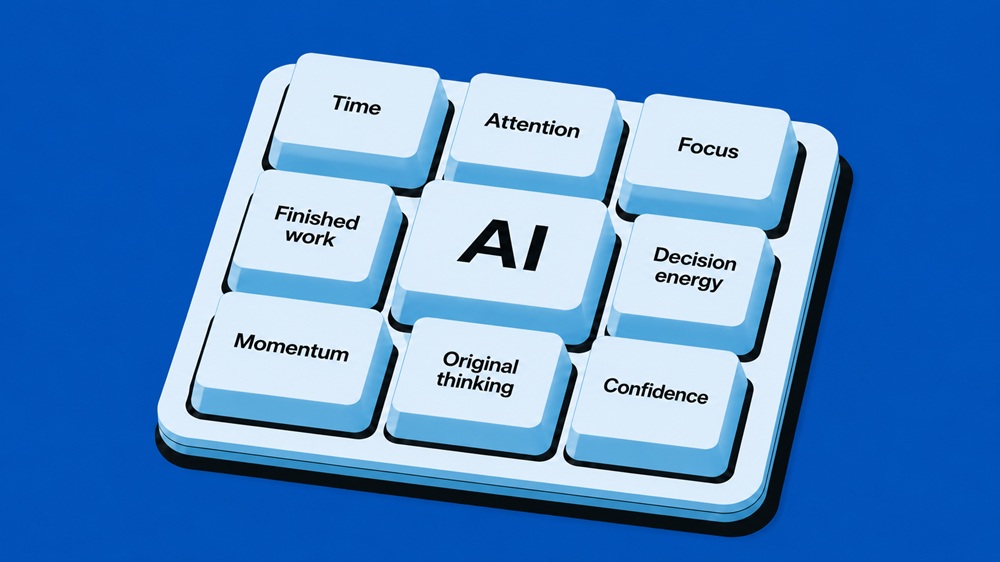
- Time: I spent so much time fixing things instead of getting started on the actual task.
- Attention: I got so immersed in prompting that I lost track of time and got stuck in the loop.
- Focus: I lost focus on blogging. I relied on AI-generated content more than what I personally wanted to convey.
- Decision Energy: I used AI to get more options. But that slowly turned into decision fatigue.
- Confidence: AI generated content reduced my confidence in my own way of writing.
- Original Thinking: Blindly following AI content and assuming it was right started blocking my original thinking.
- Momentum: AI turned a simple next step into a continuous loop of thinking, making me lose momentum.
- Finished Work: AI can produce a lot of output, making us feel productive even when nothing is actually finished.
A prompt is not free if it is taking back more than money from you.
The prompts I would stop asking
If every prompt had a cost, I would stop asking lazy, vague, or directionless prompts.
Below are a few prompts that did not help me think better.
Prompts to avoid
1. “Give me 20 ideas”: This sounds useful, but too many ideas often create more confusion.
Better: “Give me 5 practical ideas and recommend the strongest one.”
2. “Make this better”: This is too vague. AI does not know what “better” means.
Better: “Make this clearer and shorter without changing my tone.”
3. “What should I do next?”: Sometimes this is helpful. But sometimes, I already know what to do and I am just avoiding it.
Better: “I know I need to do [task]. Help me start with the smallest first step.”
4. “Give me more options”: More options are not always progress.
Better: “Help me choose between these 3 options based on speed, effort, and usefulness.”
5. “Rewrite this in 5 different ways”: This can become a perfection loop.
Better: “Give me one improved version, then explain what changed.”
The prompts I would still pay for
The goal of writing better prompts is to use AI clearly and create real value. Below are some examples:
Prompts worth asking
1. Prompts that turn messy thoughts into structure
Example: “Organize these messy notes into 3 clear points.”
Why it is worth it: It reduces mental clutter and helps you move forward.
2. Prompts that reduce friction
Example: “I am stuck on this task. Break it into the next 3 small steps.”
Why it is worth it: It helps you start instead of overthinking.
3. Prompts that summarize information into action
Example: “Summarize this into the key decisions and next actions.”
Why it is worth it: It turns information into movement.
4. Prompts that improve something you already created
Example: “Improve clarity without changing my voice.”
Why it is worth it: You stay in control, and AI supports your work instead of replacing your thinking.
5. Prompts that challenge your thinking
Example: “What is the weak point in this argument?”
Why it is worth it: It helps you improve judgment, not just generate more content.
My new rule: treat every prompt like it has a cost
Getting clear about what we need to ask or achieve is really important. That clarity decides whether we enter a whirlpool of prompting or get to the output quickly.
Start with this question:
Will this prompt help me finish my task?
Do not ask AI just because you feel stuck. Ask it because you need to finish something specific.
Examples:
- Send an email
- Choose a title
- Plan the first task
- Summarize notes
- Improve a draft
- Make a decision
Next, ask:
Will this answer reduce work or create more choices?
A good prompt should reduce friction. It should make the task:
- Clearer
- Smaller
- Easier
- Faster
- More focused
A bad prompt creates:
- More options
- More checking
- More rewriting
- More tool-hopping
- More doubt
Finally, ask:
What will I do immediately after the answer?
This is the most important question. If I do not know what action comes after the prompt, I probably should not ask it yet.
Examples:
- I will send the email.
- I will choose one title.
- I will write the first paragraph.
- I will edit the draft manually.
- I will complete the next 20-minute task.
How it changed my AI use
I believe we will soon reach a time when regular users might be charged for AI based on usage. So, learning how to use it well early on may be one of the better decisions we can make.
But more than money, using AI efficiently helps us save time. And time is an even more crucial resource.
Using these questions, I have been able to finish my tasks more quickly. I stopped asking vague questions, and I started using AI for clarity rather than perfection. As a result, it improved the quality of my work.
We should not feel guilty about using AI. At this moment, what AI really requires from us is discipline.
It is really easy to ask one more question. The harder thing to do is act on the answer.
The goal is not to ask AI fewer questions.
The goal is to ask questions that are actually worth answering.
